Updated 09-September-2026
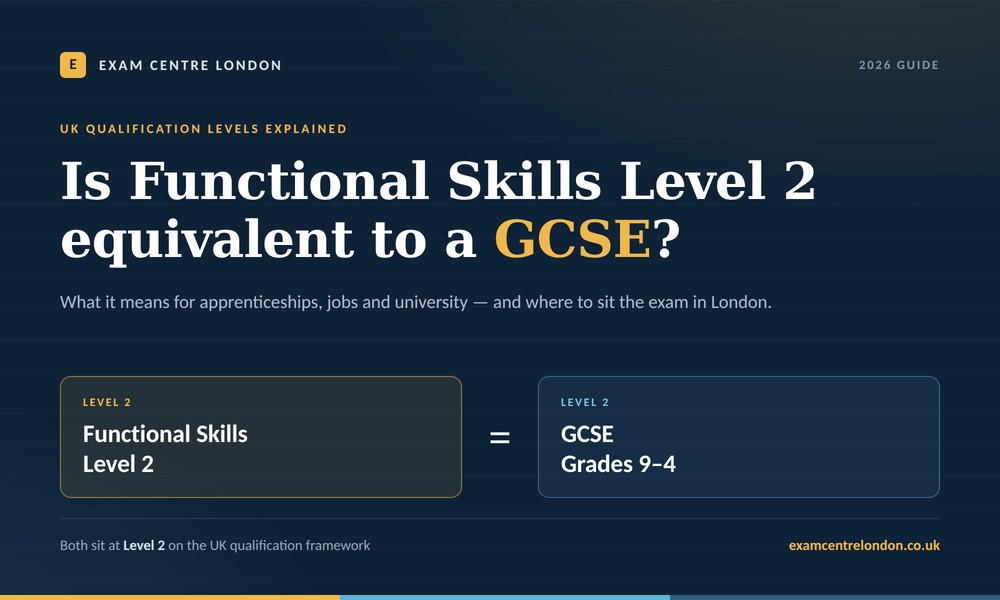
Functional Skills Level 2 sits at the same level as GCSE grades 9–4 on the UK's official qualification framework. It is accepted in place of a GCSE grade 4 in English or maths for most apprenticeships, college courses and jobs. It is not a GCSE, and a small number of universities and regulated professions still ask for the GCSE specifically.
That is the honest version of an answer a lot of websites give vaguely. Below is what sits behind it: where Functional Skills actually falls on the official framework, who accepts it, what the exam involves, and how to decide between Functional Skills and a GCSE resit.
Functional Skills are Ofqual-regulated qualifications in English, maths and ICT, designed around using those subjects in real situations — reading a workplace document, working out a rate of pay, interpreting a chart — rather than around academic study.
They exist mainly for people who need a Level 2 English or maths qualification and either did not get one at school or need one quickly. In practice that means adults returning to study, apprentices, career changers, home-educated students and anyone who has been told by an employer, college or university that they need "Level 2 maths" before they can proceed.
The current specifications were introduced for first teaching in September 2019, replacing the older Functional Skills qualifications.
This is the part worth getting precise, because the equivalence is a matter of published fact rather than opinion. The UK government's list of qualification levels for England, Wales and Northern Ireland places qualifications as follows:
Two things follow from that table.
Functional Skills Level 2 is at the same level as a GCSE grade 4 to 9. Not "roughly similar to" — the same level, on the same government framework. This is why a job advert asking for "GCSE maths grade 4 or equivalent" is satisfied by Functional Skills Level 2 maths.
Functional Skills Level 1 is at the same level as GCSE grades 3 to 1 (the old D to G). It is a genuine qualification and a sensible stepping stone, but it does not meet a "grade 4 or equivalent" requirement. If an employer or college has asked for Level 2, Level 1 will not do.
No. Functional Skills qualifications are only available at Entry Level (1, 2 and 3), Level 1 and Level 2. Level 3 on the framework is where A levels, T Levels and advanced apprenticeships sit, and there is no Functional Skills qualification there.
This question gets asked several hundred times a month, usually by people who have been told they need "Level 3 English" or "Level 3 maths". If that is you, what is being asked for is almost certainly an A level, an Access to Higher Education Diploma, or a Level 3 vocational qualification in the subject — not Functional Skills. It is worth going back to whoever set the requirement and asking exactly which qualification they mean before you enrol on anything.
Same level, different qualifications. The differences that actually matter when you are choosing:
The scheduling difference is usually the deciding one. If you find out in September that you need Level 2 maths, a GCSE means waiting until November at the earliest for a resit, or the following summer. Functional Skills can often be booked and sat within weeks.
Is Functional Skills easier than GCSE? Not easier so much as narrower and more applied. Level 2 Functional Skills maths still requires you to work with fractions, decimals, percentages and negative numbers of any size, solve multi-step problems that combine at least two processes, calculate perimeters, areas and volumes, interpret and construct statistical diagrams, work out probabilities, and handle compound measures such as speed, density and rates of pay. What it does not include is the more abstract algebra and geometry of a GCSE. People who struggled with GCSE maths as a whole subject often find Functional Skills a better fit — not because the standard is lower, but because everything in it has an obvious purpose.
Apprenticeships — yes, with one important condition. Government guidance on English and maths requirements in apprenticeships is explicit that Functional Skills counts, but only if the qualification is Ofqual-regulated. The guidance states that "only Functional Skills qualifications regulated by Ofqual can be acceptable equivalents for English or maths in an apprenticeship", and specifically warns that "certificates in Functional Skills under the Quality Licence Scheme (QLS) are not regulated by Ofqual and are not acceptable equivalents."
This is the single most expensive mistake people make with Functional Skills. There are providers selling fast, cheap "Functional Skills Level 2" certificates that are QLS-endorsed rather than Ofqual-regulated. They look official. They will not be accepted for an apprenticeship. Before you pay anyone, ask one question: is this qualification Ofqual-regulated, and which awarding organisation issues it? A legitimate provider will answer immediately with a name like Pearson Edexcel, City & Guilds, NCFE or Open Awards.
Employers — widely, yes. Any advert asking for "GCSE grade 4/C or equivalent" is asking for something Functional Skills Level 2 satisfies.
Colleges and vocational courses — generally yes, including for progression onto Level 3 courses.
Universities and regulated professions — check first. Many universities accept Functional Skills Level 2 in place of GCSE English and maths, particularly for nursing, teaching, social work and health-related courses where the requirement is expressed as "Level 2 or equivalent". Some, though, ask for the GCSE by name, and certain regulated professions do the same. If you are applying for a specific course, email admissions and get the answer in writing before you choose.
One thing that is not a difference worth worrying about: UCAS tariff points. The tariff applies to Level 3 qualifications such as A levels, so neither Functional Skills nor GCSEs carry tariff points. Your Level 2 qualification is an entry requirement, not a source of points, whichever route you take.
Booking is flexible. Unlike GCSEs, Functional Skills assessments are available on demand rather than in fixed national windows. With Pearson Edexcel, centres can enter candidates for onscreen tests up to two hours before the test, while paper-based on-demand assessments need a minimum of two weeks' notice. In practice this means a centre can usually get you a date within a few weeks rather than a few months.
There is no age limit. Pearson's guidance states there are "no set age limits for taking Functional Skills tests", though centres are asked to consider whether a learner is ready.
English is assessed in three components — Reading, Writing, and Speaking, Listening and Communicating — and you need a Pass in each. Maths is assessed with work both with and without a calculator; the exact paper format varies slightly between awarding organisations, so ask your centre which board they enter you with.
Results are Pass or Unclassified, not graded. Pearson issues results within 28 days of an onscreen test, or within 28 days of receiving a completed paper-based assessment, with certificates following about two weeks later.
Resits are straightforward. In English, if you do not pass one component you can resit just that component and carry forward the ones you passed. There is no waiting for an annual series.
Take Functional Skills Level 2 if you need a Level 2 English or maths qualification for an apprenticeship, a job, a college place or a course that accepts "or equivalent"; you are on a deadline; or you want a qualification built around practical application rather than academic study.
Take the GCSE if a university course or professional body has named GCSE English or maths specifically; you are aiming for a grade above 4 for a competitive application; or you are a school-age student for whom the GCSE is the natural route.
And if you are not sure — ask before you enrol. Email the employer, college or university, quote both options, and ask which they will accept. It takes a day and saves months.
Exam Centre London is a private exam centre in East London, open to private candidates — home educators, distance learners, adult returners and independent learners — with no requirement to have studied with us.
We offer Functional Skills English and maths alongside GCSE, IGCSE, A Level, AS Level, ACCA and AAT, and we can enter you as a private candidate whether you have prepared on your own, through an online course, or with one of our tutors. One-to-one Functional Skills Level 2 tuition in maths and English is available separately if you would like support before the exam.
If you need access arrangements — extra time, a reader, a scribe, a separate room — tell us when you enquire rather than at the point of booking, as some arrangements need evidence and lead time.
To book, or to check the next available dates:
• See current Functional Skills exam options and fees
• Ask about one-to-one Functional Skills tuition
• Review all exam fees and entry deadlines
• Read about access arrangements
• Or contact us — 0208 616 2526, info@examcentrelondon.co.uk, 54 Upton Lane, London E7 9LN
Considering a GCSE instead? See our GCSE exams for private candidates.
What is Functional Skills Level 2 equivalent to? Functional Skills Level 2 is equivalent to a GCSE grade 4 or above (grade C or above under the old system). Both sit at Level 2 on the UK government's qualification framework.
Is Functional Skills Level 2 equivalent to GCSE? It is at the same level as a GCSE grade 4–9, and is accepted in place of one for most apprenticeships, jobs and college courses. It is a different qualification, though, and a minority of universities and regulated professions ask for the GCSE specifically.
What is Functional Skills Level 1 equivalent to? Level 1 Functional Skills is at the same level as GCSE grades 3, 2 and 1 (old grades D to G). It does not meet a requirement for "GCSE grade 4 or equivalent".
What is Level 3 Functional Skills equivalent to? There is no Level 3 Functional Skills. The qualifications go up to Level 2 only. Level 3 is where A levels, T Levels and Access to HE diplomas sit.
Is Functional Skills a GCSE? No. It is a separate Ofqual-regulated qualification that sits at the same level as a GCSE grade 4–9 in English or maths.
Is Functional Skills easier than GCSE? It covers less ground and focuses on applying skills to practical situations rather than abstract topics, so many adults find it a better fit. The Level 2 standard itself is the same level as a GCSE grade 4.
Is Functional Skills Level 2 hard? It is a genuine Level 2 assessment and does require preparation, but the content is practical — percentages, areas and volumes, statistics, rates of pay — and most candidates who prepare properly pass. Because results are Pass or Unclassified, you only need to reach the standard, not compete for a grade.
How long does Functional Skills Level 2 take? Anywhere from a few weeks to a few months depending on your starting point. Because exams are on demand rather than in fixed series, you can book once you are ready instead of waiting for a national exam window.
Do universities accept Functional Skills Level 2? Many do, especially where the entry requirement is written as "Level 2 or equivalent" — nursing, teaching, social work and health courses often accept it. Some name the GCSE specifically. Always confirm with the admissions team in writing before you enrol.
Can I take Functional Skills as a private candidate? Yes. Private exam centres such as Exam Centre London enter private candidates for Functional Skills without requiring you to have studied with them.
Recent Posts
Categories
Tags