Updated 27-December-2025
If you're preparing for A-Level Maths in London, one truth is undeniable: mastering calculus concepts isn't optional—it's essential. At Exam Centre London, we've witnessed firsthand how students who truly understand differentiation and integration transform from anxious candidates into confident, top-performing examinees. This comprehensive guide breaks down these foundational concepts with clarity, connects them directly to your exam success, and provides a practical roadmap tailored for London's private candidates.
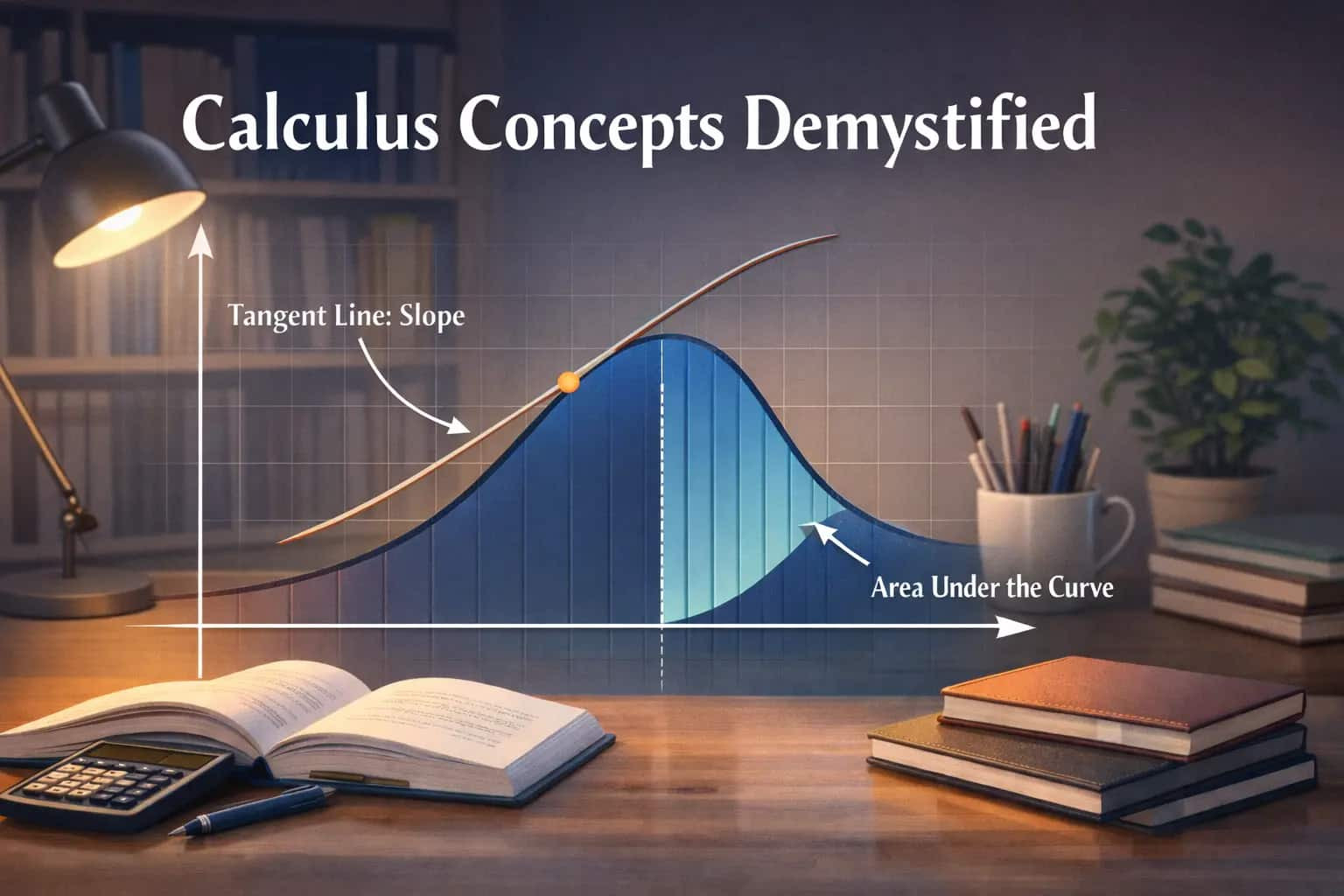
At its core, differentiation measures instantaneous rate of change—the mathematical equivalent of asking "How quickly is this changing right now?"
Beyond the Formula: While dy/dx = 3x² might seem abstract, it represents something tangible: the exact steepness of the curve y = x³ at any point. In your A-Level exams, this translates to:
Finding maximum and minimum values in optimisation problems
Calculating velocities and accelerations in mechanics
Determining growth rates in biological contexts
Common Misconception Alert: Many students confuse differentiation with simple gradient calculation. Remember: differentiation gives you the gradient function—a formula that works for every point on the curve, not just between two points.
Integration: The Mathematics of Accumulation
If differentiation breaks things down, integration builds them up. It's fundamentally about summing infinitesimal pieces to find totals.
The Area Under the Curve: Visualise integration as calculating the exact area between a curve and the x-axis. This isn't just theoretical—it's how you:
Determine distance travelled from a velocity-time graph
Calculate volumes of complex shapes
Solve real-world problems involving accumulated change
The "+C" Explained: That mysterious constant in indefinite integration represents all possible vertical positions of a function family. In practical terms, it's why you need initial conditions to solve real-world problems completely.
The true elegance of calculus lies in this profound relationship: differentiation and integration are inverse operations.
Think of it like this: If differentiation tells you how fast water fills a container at each moment, integration tells you the total water accumulated over time. One reverses the other.
This isn't just theoretical beauty—it's practical exam gold. Understanding this relationship helps you:
Verify your integration by differentiating the result
Recognise when to apply substitution methods
Solve differential equations that appear in both mathematics and science papers
Based on our analysis of past papers and examiner reports, here's how your understanding will be assessed:
Foundation First: Before practicing complex problems, ensure you can graphically explain what f'(x) represents for any basic function. Use free graphing tools like Desmos or GeoGebra to visualise relationships.
Past Paper Analysis: When reviewing past papers, categorise each calculus question by concept (differentiation, integration, application) and difficulty. Notice patterns in what examiners consistently test.
The Teaching Test: Can you explain the chain rule to someone without using mathematical notation? This "explain it simply" exercise reveals true understanding versus memorisation.
Concept Mapping: Create visual diagrams connecting all calculus concepts in your syllabus. Link differentiation techniques to integration methods, noting inverse relationships.
Professional Assessment: Consider our predicted grades service where you sit a formal mock exam under timed conditions. The feedback specifically identifies conceptual misunderstandings versus careless errors.
As a private candidate in London, you navigate calculus without daily classroom reinforcement. This independence offers flexibility but requires disciplined strategy:
Missing the iterative learning of regular problem-solving sessions
Limited access to immediate feedback on conceptual misunderstandings
Self-managing the connection between abstract concepts and exam technique
At Exam Centre London, we bridge these gaps by providing structured support that moves you from conceptual understanding to exam-ready performance.
Understanding calculus conceptually transforms how you approach your entire A-Level Mathematics qualification. It's the difference between mechanically applying formulas and intuitively solving complex problems.
For Private Candidates in London: Remember that arranging your A-Level exams involves more than just understanding the content. As a leading private exam centre, we handle the complete administration—from correct paper combinations to providing the formal setting where you can demonstrate your calculus understanding under true exam conditions.
Next Steps: Master the concepts through targeted study, then validate your readiness through formal practice. Finally, secure your exam placement with professionals who understand both the mathematical and administrative challenges you face.
Secure Your A-Level Mathematics Exam Placement Now | Discuss Targeted Calculus Support
Q1: How much of my A-Level Maths grade depends on calculus?
A: Typically 30-40% of your final A-Level Mathematics grade directly examines calculus concepts, with additional indirect applications in mechanics and statistics components. For students taking A-Level Further Mathematics, this weight increases significantly.
Q2: What's the most common calculus mistake you see in exams?
A: Students often differentiate correctly but then misapply these results in contextual problems. For example, correctly finding dy/dx but then using it incorrectly in optimisation problems. The issue isn't the differentiation skill—it's the conceptual understanding of what the derivative represents in that specific context.
Q3: I'm retaking A-Level Maths. How should I approach calculus differently?
A: Focus on diagnostic learning. Before practicing more problems, identify exactly why you struggled previously. Was it misunderstanding the fundamental concepts, exam technique, or application? Our predicted grade services provide exactly this analysis through professionally marked mock exams.
Q4: Are there particular calculus topics that London examiners emphasise?
A: While all major exam boards cover similar ground, London students consistently see stronger emphasis on applied calculus—particularly in mechanics contexts (motion problems) and in linking differentiation to curve sketching before integration finds areas between curves.
Q5: How can I check if I truly understand a concept or just memorise the steps?
A: Try the "variation test." If you can solve a problem when parameters change slightly (changing from polynomial to trigonometric functions, or altering the context of a word problem), you likely understand conceptually. If you're thrown by variations, you've memorised steps rather than internalised concepts.
Q6: What support does Exam Centre London offer specifically for calculus preparation?
A: Beyond providing the formal exam setting, we connect private candidates with specialist tutors who focus on conceptual understanding, offer formal mock exams with detailed feedback on calculus performance, and ensure you're entered for the correct combination of papers based on your strengths and university aspirations.
Recent Posts
Categories
Tags