Updated 09-April-2026
Exams are stressful events, and feeling unprepared only makes them worse. One of the simplest ways to boost your confidence before your A‑Level exams is to know exactly what is expected of you on the day. The Joint Council for Qualifications (JCQ) publishes official rules and advice for students taking GCSE, AS and A‑Level exams in the UK. By following these guidelines, you ensure a smooth exam experience and avoid penalties that could affect your results.
Arrive early and organised: Be outside the exam room at least ten minutes before the start time. Double‑check your timetable, pack your equipment the night before and allow extra time for travel.
Bring only permitted equipment: You need black pens, pencils, eraser, ruler and any specialist equipment (e.g., calculator) with covers removed. Keep everything in a clear pencil case and bring your photo ID and candidate number.
Leave banned items at home: Notes, mobile phones, smart watches, earphones or any other electronic device are classed as unauthorised material. Possession of these items, even if you don’t use them, can lead to disqualification.
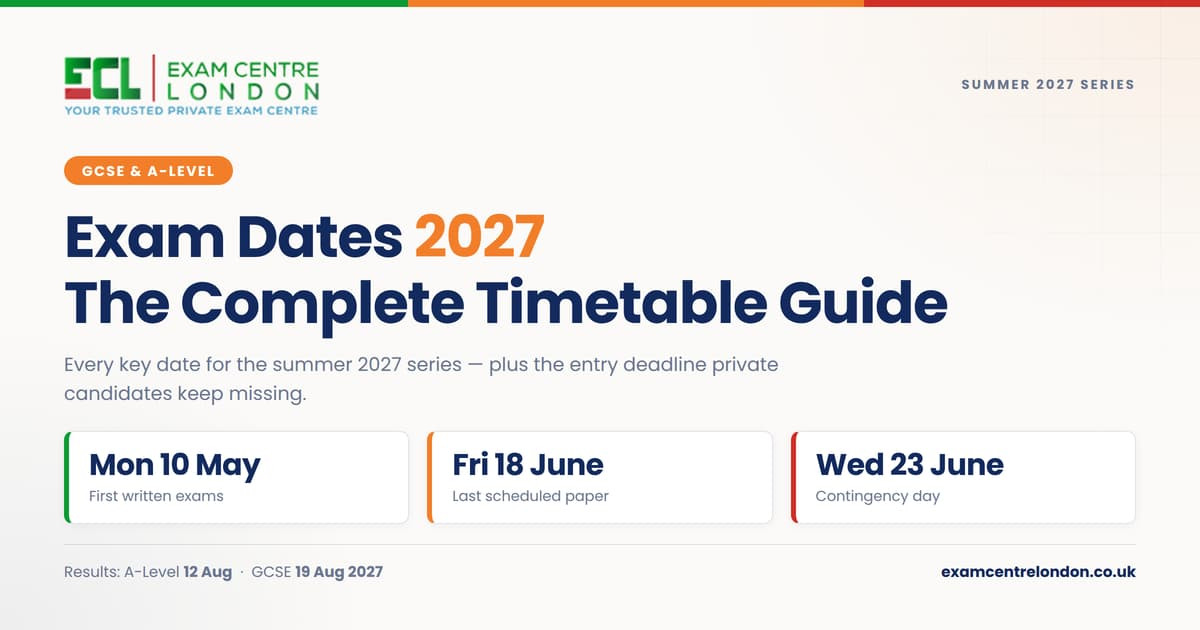
The 2026 summer exam series for AS and A‑Levels runs from 7 May to 23 June. There is also a national contingency day on 24 June in case an exam has to be rescheduled. Because of this, you must be available for the entire window, including the contingency day. There are no opportunities to sit missed papers later, so double‑check your personal timetable and make sure you know when and where each exam takes place.
Schools and colleges will provide personalised timetables detailing the subjects, dates, and start times for all your exams. You can also check the published timetables on our site – see our A‑Level Exam Timetable 2026 page for a breakdown by board and subject. Always confirm the start time; morning papers normally begin at 9:00 am, while afternoon papers start at 1:30 pm.
The JCQ is responsible for standardising exam administration across the UK. Every school and exam centre must follow JCQ’s ‘Instructions for Conducting Examinations’ and the ‘Information for Candidates – Written Exams’ documents. These guidelines cover everything from permitted equipment to procedures for late arrivals. You can read the full guidance on the JCQ website.
Although schools implement these rules locally, exam day regulations are the same nationwide. If you break a rule, even accidentally, you risk losing marks or being disqualified from all your examinations.
Bring your photo ID and your candidate number. You will need them to fill in the front of your answer booklet. Pack the following in a transparent pencil case:
At least two black pens; write clearly in black ink. Highlighters, gel pens or correcting fluid are not permitted.
Pencils, ruler, eraser and any specific subject equipment (e.g., compass, protractor). Remove any instructions or formulae printed on covers.
A calculator, if your paper allows it. Clear the memory beforehand and remove the lid or case. Do not bring instructions or pre‑programmed data.
A clear water bottle with no labels. Staying hydrated helps maintain focus.
If you have approved access arrangements, bring any permitted aids (e.g., coloured overlays). Check these with your exams officer in advance.
The JCQ makes it clear that certain items are never allowed in the exam room. Do not bring:
Notes, textbooks or revision guides.
Mobile phones, smart watches, earbuds, MP3/4 players, tablets or smart glasses. Even if switched off, possession is considered malpractice and may lead to disqualification.
Non‑transparent pencil cases or bags.
Wearable technology (e.g., fitness trackers) – remove these before you enter the room.
Invigilators will ask you to empty your pockets. Any unauthorised material found in your possession will be reported, regardless of your intention.
Listen to the invigilator and follow their instructions at all times. They will tell you when to start and finish.
Do not talk or communicate with other candidates once you enter the room.
Write clearly in black ink on the provided answer booklets. Label any extra sheets with your candidate details.
Do not use correcting pens, fluid or tape and avoid highlighters in your answers.
Rough work should be done on the proper answer paper and crossed through before handing it in.
Do not borrow equipment from anyone else. If you have forgotten something, raise your hand and an invigilator will assist you.
If you need to leave the room, an invigilator must accompany you and you may not return unaccompanied.
Aim to arrive at least ten to fifteen minutes before the published start time. Being punctual allows for any last‑minute announcements and helps you settle in calmly. If you are running late, contact your school or centre immediately. They will advise you on what to do when you arrive.
Candidates who arrive more than an hour late may not be allowed to take the exam, depending on the exam board’s regulations. If you manage to enter the exam hall late, your finishing time will not change; you must stop writing when instructed.
If you’re unwell on exam day, notify your school as soon as possible. In some cases, you may qualify for special consideration, but you should never assume that a missed exam can be rescheduled. Check the GOV.UK exam advice for further guidance.
Calculators often cause confusion. Always consult your exam board’s specific rules. As a general rule:
Check that your calculator is working and has fresh batteries.
Clear any stored data before the exam.
Remove any printed instructions or formulae on lids or covers.
Avoid advanced functions that are not permitted for the paper you’re taking.
If you are unsure whether your calculator is acceptable, ask your teacher or exams officer well before exam day.
Pack the night before: Lay out your ID, stationery, admission slip and travel arrangements so you’re not scrambling in the morning.
Get a good night’s sleep: Aim for at least seven hours. Avoid cramming the night before; sleep improves memory consolidation.
Eat a balanced breakfast: Choose slow‑release carbohydrates (e.g., porridge, wholegrain toast) and protein (e.g., eggs, yogurt) to maintain energy levels.
Dress comfortably: Wear layers so you can adjust to the exam room temperature.
Take deep breaths: If you feel anxious, practise slow breathing. Inhale deeply for four counts, hold for four, then exhale slowly for four counts.
Focus on your paper: Don’t worry about what others are doing. Follow your own plan for reading, planning and answering questions.
To make the most of your exam preparation, explore related articles and revision tools on our sites:
Knowing the official A‑Level exam day rules can make the difference between a smooth, focused exam experience and unnecessary stress. By arriving early, bringing only approved items and following the invigilators’ instructions, you protect your hard work and give yourself the best chance of success. Combine these exam day tips with strategic revision – including our free resources – and you’ll be ready to tackle your 2026 A‑Level exams with confidence. If you found this guide helpful, share it with friends and classmates to help everyone perform at their best.
Recent Posts
Categories
Tags